

Facial redness: why your skin reacts and how to soothe it
Your face turns red at the slightest temperature change, after a hot shower, a glass of wine, or a stressful day. Your cheeks feel hot, your skin feels tight, and your makeup never sits the same way from one day to the next.
This redness is not a matter of hygiene or a lack of skincare. In the vast majority of cases, it indicates skin with a weakened barrier that reacts faster and more intensely than others. The good news: this is something you can address, provided you do less rather than more.
Here is what is really happening, what keeps the problem going without you realizing it, and how to build a routine that soothes instead of aggravating.
Why skin turns red
Redness is a normal skin response. The blood vessels just beneath the surface dilate, blood flow increases, and the area warms up and turns pink. For most people, this reaction disappears in a few minutes.
With reactive skin, two things change. The vessels dilate more easily, triggered by increasingly common factors. And they take longer to return to normal—until, for some, the redness ends up becoming permanent on the cheeks, nose, or chin.
Behind this increased sensitivity, there is almost always a weakened skin barrier. This barrier is a film composed of lipids and cells that retains water inside the skin and blocks external aggressions. When it is damaged, the skin loses water faster, becomes dehydrated, lets in what it should filter out, and reacts to everything.
This is why redness, tightness, and sensitivity almost always happen together. They are three symptoms of the same problem.
What triggers redness
Triggers are unique to everyone, but common ones include:
Temperature variations. Moving from cold to hot is the most frequent trigger. Going out into the wind, entering a heated room, taking a hot shower, standing near a radiator.
The climate. Wind, dry cold, altitude, and sun weaken the skin barrier. Reactive skin types who live in the mountains or spend their weekends there notice this every winter.
Diet and alcohol. Spicy foods, hot drinks, and alcohol—red wine in particular—cause rapid dilation of the vessels.
Stress and emotions. The reaction is immediate and perfectly visible, which often fuels a vicious cycle: you blush, you become aware of it, and you blush more.
Hormones. Pregnancy, your cycle, perimenopause: hormonal shifts change the skin’s vascular reactivity.
Cosmetics. This is the most underestimated trigger, and the only one you have total control over.
Habits that aggravate redness without you knowing
Most reactive skin types we see in the treatment room don't suffer from a lack of care. They suffer from an excess.
Water that is too hot. Cleaning your face with hot water dilates vessels and dissolves part of your lipid film. Use lukewarm water, systematically.
Scrubs. On skin that turns red, a weekly mechanical scrub maintains the barrier’s fragility rather than repairing it.
Accumulating active ingredients. An acid serum in the morning, a chemical exfoliant in the evening, a scented cream on top: each product taken in isolation might be fine, but the stacking is not.
Constantly changing your routine. Reactive skin needs consistency. Testing a new product every two weeks never gives you time to observe results or identify what doesn't suit you.
Textures that "absorb quickly." These are often loaded with alcohol or volatile agents; while pleasant in the moment, they do not provide the lipids the barrier needs to rebuild itself.
What a cosmetic routine can and cannot do
Let's be clear, as this subject is saturated with empty promises.
A suitable cosmetic routine can improve skin comfort, visibly reduce redness linked to reactivity, limit tightness, and space out flare-ups. That is already a lot, and it is measurable on a daily basis.
It does not replace medical advice. If your redness is permanent, accompanied by bumps, visible vessels, or burning sensations, or if it worsens despite a gentle routine, see a dermatologist. Some situations require treatment, and a good cream will not change that. A suitable cosmetic approach acts as a supplement, never as a replacement.
The routine that soothes
The principle is simple: fewer products, more lipids, and regularity.
Morning
Cleanse with lukewarm water, without rubbing, or just a simple rinse if your skin is very reactive.
Lacté Serum. A botanical retinol serum formulated for skin that doesn't tolerate traditional retinol. Apply it in the morning, under your cream.
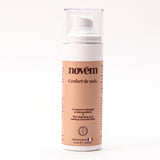
Éclat de Noix Cream. This is our benchmark product for redness. Its lipid base derived from walnuts nourishes the skin barrier rather than stimulating it. 98.5% naturally sourced, Victoire de la Beauté 2025 winner.
Sun protection. Non-negotiable for reactive skin, even in winter and in the mountains, where reflection amplifies exposure.
Evening
Remove makeup with a balm, then rinse with lukewarm water.
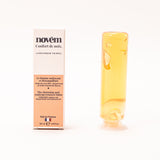
Joli Minoix Oil, alone. No serum, no cream on top. The night is when the skin repairs itself: provide what it needs, and let it do the work.
This combination—the cream in the morning, the oil in the evening—is what we call the Anti-Redness Duo. It is our primary recommendation for skin prone to redness, and it is the starting point we suggest in our boutique.
How long before you see results
Comfort often returns in a few days: less tightness, skin that "handles" the day better. As for the intensity of the redness, it evolves over several weeks, because the skin barrier takes time to rebuild. Count on one full cycle, or about a month, before judging.
And above all: change nothing during this period. It is the most difficult rule to keep, and the most decisive.
Why walnuts
Novëm was born from a simple observation: walnut lipids have a composition particularly close to what a damaged skin barrier needs to reconstitute itself. This is what we call Nucithérapie®, and it is the common thread in all our formulas.
Walnuts are purchased directly from our producers in Cognin-les-Gorges, in partnership with the Ferme Michallet, and we then formulate and create within a 100 km radius of Grenoble. A short supply chain, tracked raw materials, and formulas built for skin that can no longer tolerate much.
More than 10,000 customers currently use our skincare products.
Get support
If you don't know where to start, the simplest thing is to talk to someone.
In our boutique at 1 rue Millet in Grenoble, routine advice is free, and the entire range can be tested. We also offer cabin treatments—the Nuciglow® for radiance and comfort, the Nucisculpt® for a more sculpting effect—which allow you to see how your skin reacts before committing to a routine.
Our products are also available in more than 50 partner pharmacies: your pharmacist is often the best first point of contact for this subject.
Frequently asked questions
Can redness disappear completely? It depends on the origin. Redness linked to reactive skin and a weakened barrier diminishes significantly with an appropriate routine and the avoidance of triggers. Permanent redness with visible vessels requires dermatological advice.
Can I use retinol if I have redness? Traditional retinol is often poorly tolerated. A botanical retinol, applied in the morning under a lipid-rich cream, is better tolerated. Introduce it gradually and observe.
Should I stop wearing makeup? No. But always remove it with a balm rather than micellar water left on the skin, and rinse with lukewarm water.
Are redness and rosacea the same thing? No. Rosacea is a dermatological condition that is diagnosed and treated medically. Reactive skin that blushes is not necessarily rosacea. If in doubt, consult a professional.

