

Anti-redness skincare is one of the most frequent requests in natural cosmetics. And for good reason: reactive skin, diffuse redness, and early-stage rosacea affect an increasing portion of the population—especially in urban environments, where pollution, stress, and unsuitable cosmetics perpetuate underlying skin inflammation. But calming redness naturally cannot be improvised: you have to understand its origin, identify truly effective active ingredients, and build a consistent routine that doesn't reactivate what it claims to soothe. This article is the practical guide you deserved—expert, without unnecessary jargon, rooted in science but accessible to everyone.
1. Why does my skin turn red? The mechanisms to know
The cutaneous vascular response
Skin redness is the result of vasodilation of the capillaries in the superficial dermis. When the skin perceives an aggression—thermal (heat, cold), chemical (irritating ingredient), mechanical (friction), or immunological (allergen)—it triggers an inflammatory cascade that includes the release of histamine and prostaglandins. These mediators cause the dilation and increased permeability of small blood vessels, hence the visible redness. On reactive skin, this trigger threshold is lowered: the vascular response goes into overdrive for stimuli that "normal" skin tolerates with ease.
The weakened skin barrier: the gateway
In the vast majority of cases, skin prone to redness has a weakened skin barrier. This lipid barrier—composed of ceramides, linoleic acid, alpha-linolenic acid, and cholesterol—is what protects the epidermis from external aggression and maintains its hydration. When it is altered (by cold, wind, harsh surfactants, or a genetic deficiency in filaggrin), irritants penetrate more easily and the inflammatory response goes into overdrive. Strengthening the barrier is therefore an essential step in any anti-redness care. We explain this in detail in our article on
essential fatty acids and the skin barrier: how omega-3 protects your skin.
2. Rosacea, couperose, sensitivity: clearly distinguishing the causes
Reactive skin without pathology
Many people have naturally reactive skin—without any diagnosed dermatological pathology. They flush easily in response to heat, cold, spices, alcohol, or stress. This vascular hyperreactivity is often aggravated by unsuitable cosmetics (too rich, too fragrant, too exfoliating) or by a pro-inflammatory lifestyle (chronic stress, unbalanced diet, lack of sleep). This is not a disease but a skin profile that requires special attention when choosing skincare products.
Rosacea: recognizing the signs
Rosacea is a chronic inflammatory dermatosis that affects approximately 10% of the Caucasian population. It manifests as persistent redness (centrofacial erythema), vasomotor flushes, papules and pustules in more advanced forms, and sometimes an ocular component (ocular rosacea). Rosacea is aggravated by heat, sun, alcohol, spices, certain cosmetics, and stress. It is not cured by cosmetics, but adapted anti-inflammatory skincare can significantly reduce flare-ups and improve daily comfort.
Couperose: permanent visible capillaries
Couperose refers to the permanent visibility of small, dilated blood vessels (telangiectasias) on the cheeks and nose. It is often a progression of rosacea or an independent vascular condition. Unlike reactive redness, couperose vessels are permanent and do not respond to cosmetics alone: the definitive solution is vascular laser treatment. However, an adapted anti-inflammatory routine can prevent worsening and improve the skin's overall appearance.
3. Active ingredients that truly calm redness
Alpha-linolenic acid (omega-3): inflammation modulator
Alpha-linolenic acid is the most underrated anti-redness active ingredient in natural cosmetics. By modulating the prostaglandin cascade, it directly reduces the intensity of the vascular inflammatory response. Several dermatological studies have confirmed its effectiveness in reducing erythema on atopic and reactive skin. Organic walnut oil is one of the richest plant sources of ALA—which is precisely why Novëm makes it the pillar of its Anti-Redness Routine.
Walnut phytosterols and polyphenols
Phytosterols inhibit pro-inflammatory cytokines (IL-1β, TNF-α) that cause vasodilation. Walnut polyphenols (ellagic acid, tannins, juglone) act upstream by neutralizing free radicals and inhibiting the NF-κB factor, the conductor of inflammation. Together, they form a natural soothing duo that is particularly effective on reactive redness.
Bisabolol and centella asiatica extract
Bisabolol, extracted from German chamomile, is one of the most well-documented soothing active ingredients in cosmetology. It inhibits the production of pro-inflammatory cytokines and reduces skin sensitivity. Centella asiatica (gotu kola) acts on both inflammation and vascular remodeling: it strengthens capillary walls, thereby reducing their tendency toward excessive vasodilation. Both these active ingredients are found in the most advanced anti-redness cosmetic formulas.
Niacinamide (vitamin B3): complexion unifier
Niacinamide is one of the best allies for skin prone to redness. It reduces melanin production (for dark spots) but also local inflammation via the inhibition of TNF-α. It strengthens the skin barrier by stimulating ceramide synthesis and improves cutaneous microcirculation in the long term. Its tolerance is excellent, even on very sensitive skin.
4. What NOT to put on skin prone to redness
The major culprits to ban
Several cosmetic ingredients are particularly problematic for reactive and redness-prone skin:
- Synthetic fragrances and high-dose essential oils: primary contact allergens, triggers of inflammation.
-
Menthol and camphor: a deceptive "freshness" effect that causes cutaneous vasodilation.
-
Low-pH alpha-hydroxy acids (AHAs): effective exfoliants but irritating for skin already weakened.
-
High-concentration retinol: powerful but irritating—to be introduced very gradually if necessary.
-
Harsh surfactants (SLS, SLES) in cleansers: destroy the lipid barrier with every wash.
The error of over-exfoliation
A very common mistake for those with redness-prone skin: trying to exfoliate to "remove the redness." Not only does exfoliation have no effect on the vascular cause of redness, but it further weakens an already compromised barrier. If you must exfoliate your reactive skin, do it at most once a week, with a gentle enzymatic exfoliant, and never on inflamed skin.
5. The ideal anti-redness routine: step by step
Morning: protect and calm
Step 1—Cleansing without foam or with alcohol-free micellar water: the Novëm Cleansing Balm, based on walnut oil, is ideal for a gentle cleanse that respects the barrier.
Step 2—Anti-inflammatory serum (a few drops of Novëm Soothing Face Oil or Milky Serum).
Step 3—Light moisturizing and soothing cream (Novëm Day Cream, award-winning at the Victoires de la Beauté).
Step 4—Mineral sun protection (zinc oxide only; potentially irritating chemical filters should be avoided).
Evening: repair and rebuild the barrier
Step 1—Fragrance-free oil makeup removal.
Step 2—Repairing skincare rich in essential fatty acids: Novëm Soothing Face Oil is perfect, applied to slightly damp skin.
Optionally, the Milky Serum can be used 2 to 3 times a week for its anti-aging action without irritation. No exfoliant, no retinol on evenings when the skin is "in crisis."
As a treatment course: boost the soothing effect
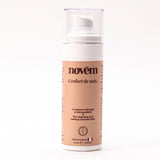
If your skin is particularly reactive during a certain period (change of season, stress, post-travel), you can intensify with the Novëm Anti-Redness Routine, which combines Cleansing Balm, Soothing Face Oil, and Day Cream in a systemic approach. Over 4 weeks of a regular routine, reactive skin generally observes a significant reduction in the frequency and intensity of redness episodes.
FAQ—Your questions about anti-redness skincare
Can anti-redness skincare replace medical treatment for rosacea?
No. Rosacea is a chronic disease that requires dermatological follow-up. Natural anti-redness skincare can be an excellent supplement to improve daily comfort, reduce reactivity, and support the skin barrier—but it does not replace prescribed treatments (metronidazole, azelaic acid, ivermectin). Discuss it with your dermatologist to incorporate an appropriate natural skincare product into your protocol.
Is walnut oil really suitable for oily, redness-prone skin?
Yes—Walnut oil has a very low comedogenicity index (1-2/5) and a semi-dry texture that absorbs quickly. For combination to oily skin prone to redness, a few drops as a serum under a light cream are sufficient. Avoid applying it in large quantities like an occlusive balm.
How long until I see visible improvement?
The first improvements (skin less "tight," redness less intense after meals or exposure to cold) are generally noticeable after 2 to 3 weeks of a regular routine. A lasting and structural improvement—linked to the rebuilding of the barrier and the reduction of chronic inflammation—requires 6 to 8 weeks. Be patient and regular: reactive skin hates abrupt changes in routine.
Conclusion
Calming redness naturally means first and foremost understanding its mechanics: a weakened barrier, underlying inflammation, and vascular hyperreactivity. The active ingredients that really work—omega-3s, polyphenols, phytosterols, bisabolol—act on these mechanisms rather than just the appearance. And a consistent, minimalist, and stable anti-redness routine is worth more than the accumulation of "soothing" products with contradictory formulas. Novëm has built an entire range around this philosophy—and the results speak for themselves.
Read also: Complete guide to anti-inflammatory cosmetics · Skin barrier and omega-3s
→ Discover the Anti-Redness Routine and Sensitive Skin Essentials → novemlab.co

